I have recently been re-engaging scholarship on Paul Gauguin, in part because I have been making the final corrections to my book, Gauguin’s Matriarchy, soon to be released through Cambridge Scholars Publishing! 📖 🎉 This is the first of my books that will be released through a non-Ediciones Pluma Verde publisher, so I am doubly excited about its upcoming publication.1
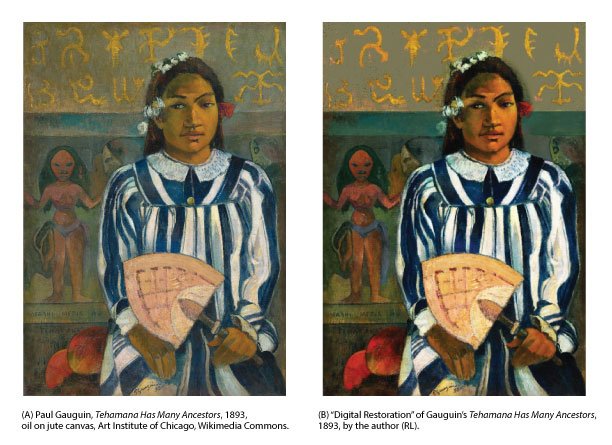
Anywho, as I have been making revisions and reviews, I stumbled upon Gauguin’s Teha’mana Has Many Ancestors (1893), an oil on jute (sackcloth) painting of his first Tahitian companion. Gauguin completed this painting during his initial sojourn to French Polynesia—an archipelago famously visited by Captain James Cook in 1767. Though not without the usual share of conflict, during their months-long stay in Tahiti, Cook’s crew ate, hung out, and traded with the locals with some success. When the time came for departure, one of the locals, an areoi named Tupaia, decided to join Cook in his oceanic charting mission.
As a holy man who followed the cult of Tane (though some also say Ta’aroa), Tupaia was responsible for sharing and preserving the oral tradition of the Society Islands through the extensive memorization of chants, myths, language, and multiple navigational systems for extensive intra-Pacific travel. Polynesians were exceptionally adept seafarers who traveled the Pacific in large canoes, reaching as far as Rapa Nui (Easter Island) and New Zealand onwards the 10th century. As such, they share many elements of the culture, to such an extent that Tupaia had no problem communicating with a Māori chief during their voyage to New Zealand, even though he had never been to the island.2
In Noa Noa, a semi-fictionalized (if not occasionally symbolic) account of his first visit to Tahiti, Gauguin shares how he met Teha’mana during an expedition to the center of the island, led in search of a native wife. Some scholars have argued that she was an artistic invention, though Teha’mana’s existence has been proven through photos and accounts revealed to the anthropologist Bengt Danielsson, later documented in Gauguin in the South Seas. Danielsson regarded Gauguin’s love for Teha’mana as “anthropological,” driven by his social-cultural (and increasingly political) curiosity for Tahiti. Danielsson’s theory is partially supported in Noa Noa, where Gauguin explained that he strove “to see” through Teha’mana’s eyes. In various instances he also places Teha’mana as the source of his mythological knowledge, even though scholars argue that Teha’mana could not have known these myths to the extent described by Gauguin. Still, the fact that he chose to regard her as an authority is true to the “matriarchal” character of the culture, who once argued that the moon was a woman’s first husband.3
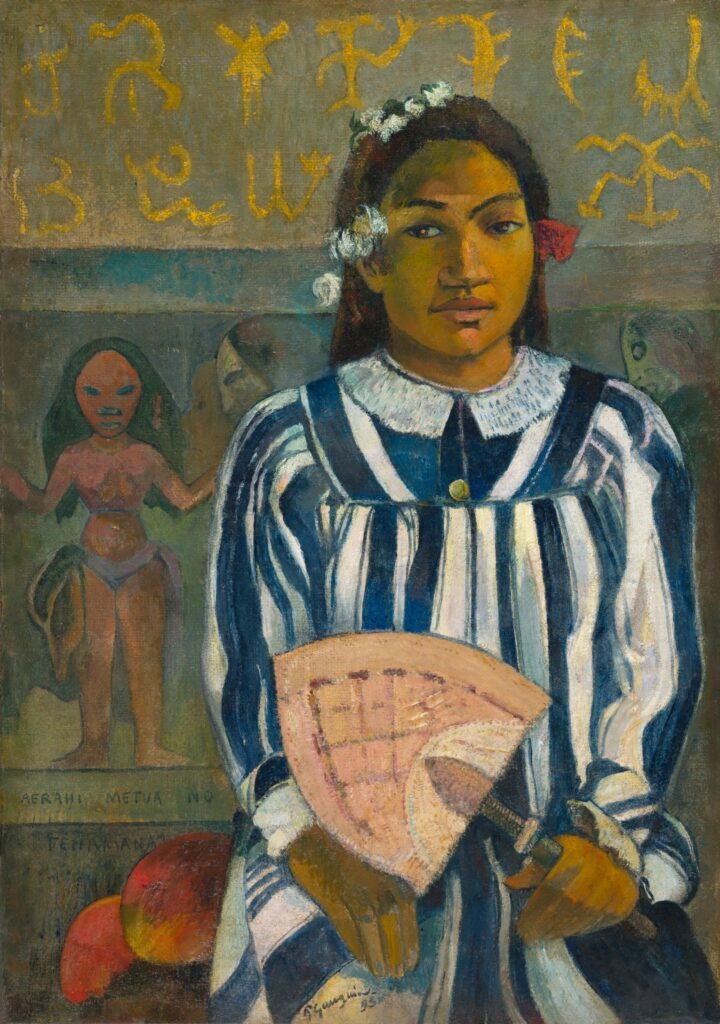
Teha’mana Has Many Ancestors seems to allude to all of these events through the myriad symbols in the composition. Her fan is Samoan and the glyphs in the background are based on the rongorongo carved script invented by the Rapanui in Easter Island. The Rapanui were the only Polynesians who invented a writing system, so their creation is at once mysterious and intriguing. These glyphs in particular correspond to the Tahua tablet, sent to Paris by Tepano Jaussen, Bishop of Tahiti, in the 1880s, after attempting to decipher the wooden glyphs with little success. Though Gauguin could not have seen the tablet in Tahiti, he did gain access to a photograph during the International Exhibition of 1889. In any case, both Jaussen and Gauguin copied glyphs from the tablet—the former for scholarly purposes, the latter for Teha’mana’s portrait.4
To commemorate this wonderfully symbolic painting, I decided to “restore” the rather faded digital copy available in the Public Domain. Mostly, I was struck with a great curiosity for how the painting must have looked after completion. Due to Gauguin’s penchant for color, Teha’mana Has Many Ancestors must have looked quite vivid during its original years. Armed with some (perhaps rather good) knowledge of Gauguin’s working palette, I set off to retouch the portrait in good ol’ Adobe Photoshop 2026, using an RGB profile. Edits were, for the most part, actual digital brushstrokes in teal, beige and copper, occasionally texturized to preserve some of the existing character of the canvas. Opacity and layers were adjusted to create the desired outcomes as needed.
And so the image went from that (… a still pretty good photo replica of the painting):
… to this (hopefully accurate, vivid “digital restoration”):
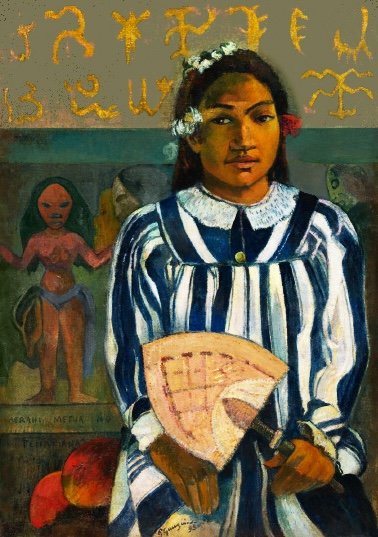
Using the “color picker” tool, colors were sourced from the edges of the corresponding design element, because they seemed to be the most intense and well-preserved. Thus, the stripe behind Teha’mana’s head is now more vividly and uniformly teal, and the “frieze woman”’s hip covering is now slightly more lavender.
Hopefully this updated photo can improve digital study of the painting. I for one love how it came out! I like to think that Gauguin would approve. It seems to be noticeably brighter without sacrificing integrity of hue, and the saturation is fairly realistic and balanced for a Gauguin painting.
Let me know what you think! You can send comments to hello@robmarielopez.com.
Updates on Gauguin’s Matriarchy to follow!
- Which… nothing wrong with that. We strive for quality! But it’s cool to have a manuscript reviewed and accepted for publication elsewhere 🙂 ↩︎
- Christina Thompson’s Sea People and Joan Druet’s Tupaia are excellent sources ↩︎
- Sources various, though I discuss some of this in detail in Lopez, 2025 (a, b) ↩︎
- op.cit. (or ibid, if you’re more APA-inclined) ↩︎