Sometimes, as scholars, we get the urge to look up how our papers have been faring. I don’t do it often, but I did it recently and was pleasantly surprised!
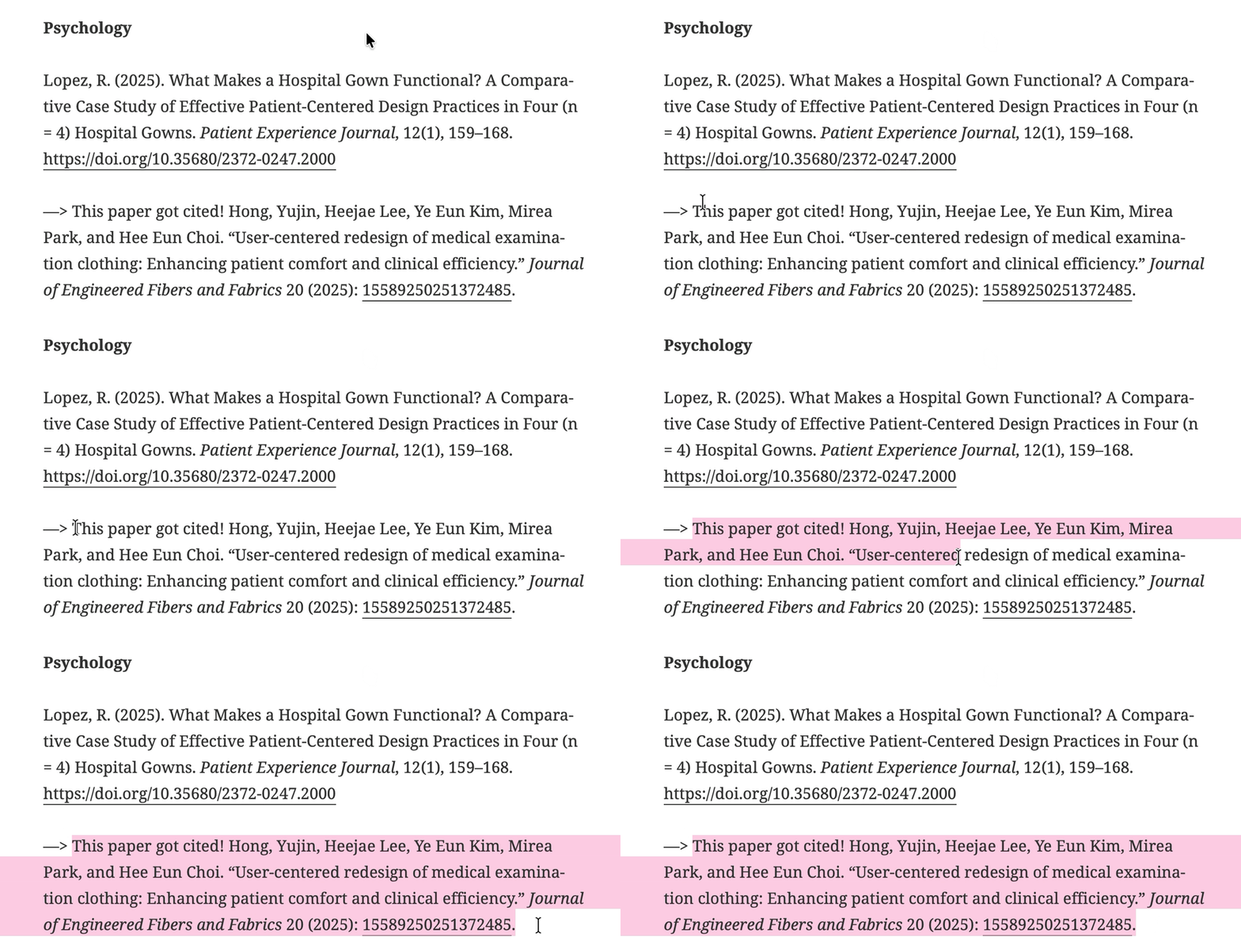
For instance, my paper on hospital gown redesigns as patient-centered interventions has been cited by Hong et al. (2025) in a mixed-methods study published at the Journal of Engineered Fibers and Fabrics. It is rather encouraging, as a scholar/researcher, to know that some of your work has contributed meaningfully to the field. In this case, their study sought to optimize the hospital gown for a specific population, with effective results. I’m glad it worked out!
Some of my art-historical work has been cited as well. For instance, the paper: “Of Women Pioneers, Relics and Proto-Abstractions: A Visual Analysis of O’Keeffe’s Manhattan” was recently cited in Pichranan’s “A Transitional Period in Life: A Study of Georgia O’Keeffe’s Artworks During a Period of Mental Loss (1929–1936).”
Likewise, my paper on Gauguin’s Eve (1890) has been integrated into coursework at Jawaharlal Nehru University! This was an exciting find, and I hope that the research completed has been engaging and insightful for students and scholars of Gauguin.
Check out the newly-updated “Writer” page for more info!
And… if you’re an art-historical (or interdisciplinary) researcher and would like to collaborate (or discuss ideas), feel free to reach out! hello@robmarielopez.com.
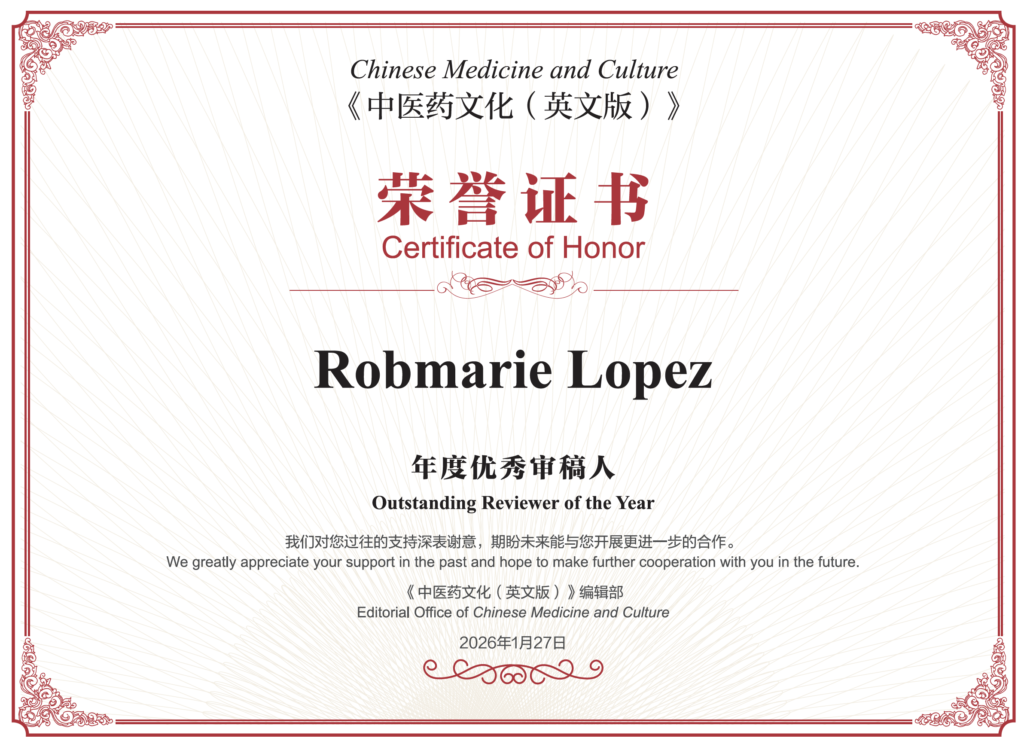
Hello everyone! Thank you for visiting my online portfolio! I suppose there is no better way to officially inaugurate RL version 2.0 by sharing some great news: I was chosen as Outstanding Reviewer of the Year (2025) by the editorial office of the Chinese Medicine and Culture, an academic journal.
What an awesome honor! It has been quite rewarding in itself to provide insights to the manuscripts which are sent my way.
To celebrate my time at the journal, here are some of the published articles which I had the opportunity to review:
“Anatomical Retrofitting: Pi (脾) as Spleen and the Persistence of Ontological Ambivalence” by LI, Lan A.
One of the first articles I had the opportunity to review. Li coherently introduces the reader to the history of Pi (the Spleen meridian in traditional Chinese medicine) and its evolution as a concept throughout the years. As what is perhaps a surprising point for Western practitioners, the Spleen meridian once included the functions of the pancreas, pointing to the complexity of TCM understanding.
In a case of Western medicine reflecting what was already well-known in TCM, a study which analyzed the effect of particular digitalized vocalizations on TCM meridians found that the Hu vocalization, ranging from 2000 – 5000 Hz, positively affected the Spleen meridian (in that it actually produced a quantifiable response), supporting the dynamic nature of internal viscera as Li’s paper found.
“A Preliminary Study of the Relevance of Zhu You Shu and Narrative Medicine” by SUN, Qimeng; ZHAO, Lan; BAI, Xuerui; JIANG, Jiabao; QIU, Nan.
This quality paper explains the foundations of Zhu You Shu, a form of spiritual healing in traditional Chinese medicine, to establish a parallel with the three focuses and three elements of narrative medicine—an intervention which is very similar to narrative psychotherapy in principle and practice.
While the paper overall is solid work, the inclusion of case examples are especially useful for the reader/clinician who wishes to view Zhu You Shu in action. Also relevant are the figures, particularly figure 3, which explains the interoperability (or association) between Zhu You Shu and Narrative Medicine. One can see how both work together like a woven thread, guiding the patient’s narrative towards healthy, psychological closure, following the resolution of their symptoms.
“Clinical Humanistic Needs of Chinese Medicine Treatment of Chronic Urticaria from the Perspective of Narrative Medicine” by LIU, Shuchen; REN, Tengfei; Yaqoob, Muhammad Danish; ZHOU, Rongxin
Another interesting paper which reconceptualizes the TCM treatment of chronic urticaria from the perspective of narrative medicine. Specifically, such a treatment helps assess and treat non-biological causes of chronic urticaria, to improve the effectiveness of resulting interventions.