Hello friends! I hope that y’all fare well during these brutal heat waves. Well, for us in the Northern Hemisphere, at least—and, specifically, those of us in the US’ West!
Anywho, I have some exciting news to share. For those who have supported my book, Cineterapia: Película Cómo Metáfora (Una Introducción): First of all, thank you sincerely for your continued support! 🎉 The book has fared relatively well across marketplaces, and I value your engagement with what is a perennially interesting—and increasingly relevant—topic of discussion in the field of wellness.
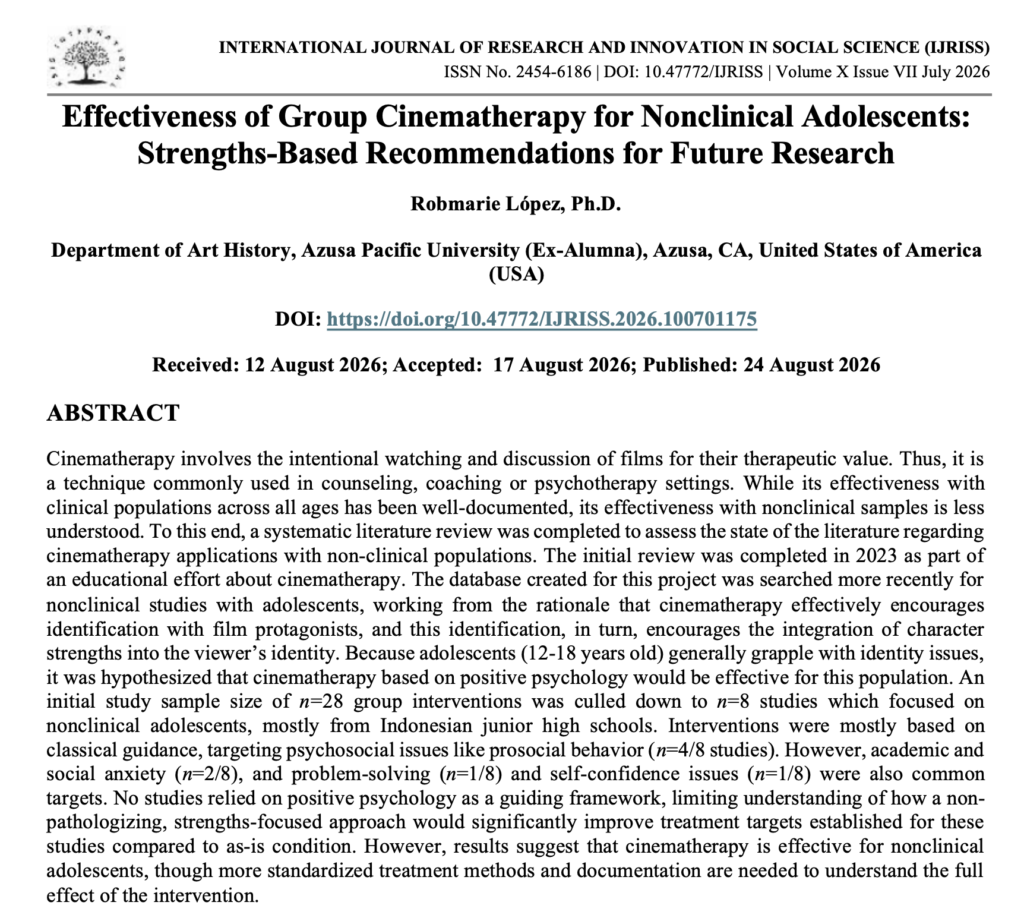
Well, for those of you who may have been interested in the book, but do not speak the Spanish language, I offer a glimmer of hope: I have recently published part of the original literature review over at the International Journal of Research and Innovation in Social Science! The paper focuses on a trend spotted during the original review: the use of cinematherapy as a counseling intervention for nonclinical adolescents in middle school. As it turns out, cinematherapy is quite popular across Indonesian schools, so the bulk of studies retrieved stem from Indonesian samples. Though this slightly limits generalizability of results, it is an interesting finding in itself, pointing to a need for cross-cultural validity studies on cinematherapy, as well as a need for studies about the particularities of cinematherapy’s effectiveness for Indonesian populations per se. Nevertheless, some findings stand out for reflection:
#1: Most counselors sought to foster prosocial behaviors in junior high schoolers: Out of n=8 studies selected, 4 of those aimed at improving prosocial behaviors like altruism and greater cooperation among middle schoolers with “antisocial behaviors.” From what could be inferred from the papers, this is not antisocial behavior in the clinical or criminal sense, but developmentally natural behaviors that generally ramp up in adolescence, i.e. increased competitiveness, decreased cooperation, etc. These studies mostly used cinematherapy as an adjunct to classical guidance, though one of them, a study by Herfidawati, Wibowo, & Purwanto (2021), addressed cinematherapy as a technique within a social modeling theoretical framework (vs. Role Playing vs. Combined). All studies were reportedly effective at improving prosocial behaviors, but not all of them shared the films used for these interventions, limiting fullness of understanding or applicability for other populations. Nevertheless, films like It Turns Out, Changed, Final Exam (Khoiri, Suroso, & Farid, 2023) and Rumah Without a Window or Blink and Pencil (Maretha, Susanti, & Sari, 2020) were effective at improving empathetic concern and improved understanding of prosocial behaviors. However, Herfidawati, Wibowo, & Purwanto (2021) found no significant differences in effectiveness across groups, suggesting that a revisitation of method or theoretical framwork would be useful to address in future studies.
#2: Two studies used cinematherapy as an adjunct to Cognitive-Behavioral Therapy (CBT) for improved problem-solving skills. These studies, led by Rimonda et al., targeted social (2018) and academic (2020) anxiety through bi-weekly, 90-minute sessions, for 4-6 weeks. Especially interesting was the social anxiety cinematherapy intervention, measured against self-talk only and a combined CBT + Self-Talk intervention. While all interventions were effective at decreasing anxiety at post-test, the cinematherapy intervention was slightly more effective at follow-up. It is possible that the multi-sensory nature of cinematherapy facilitated an understanding of the concepts discussed, in a sense decreasing the cognitive load generated by self-talk by relying on audiovisual means. However, it is also possible that the cinematherapy intervention was simply more engaging. However, let us not dismiss this engagement as trite: according to Niemec (2020), cinematherapy’s effectiveness relies, in part, on the ability to identify with the protagonist. Thus, by identifying both their woes and the character traits that allow the protagonist to overcome them, the client is able to “download” into awareness a new way of solving problems.
Due to the nonclinical nature of the problems addressed (and the samples who participated), it was somewhat surprising that positive psychology approaches (also known as “strengths-based”) were not used as the theoretical foundations for these studies, given their focus on building natural-occurring strengths like creativity, resilience, and altruistic behavior. Studies in positive psychology are unfortunately under-represented in the overall wellness milieu, though those that exist are particularly well-supported. Mihalyi Cziksentmihalyi’s research on flow states and creative problem solving are ever-applicable across industries today. In any case, because the student population is nonclinical, a strengths-based approach would perhaps be more appropriate in practice, if not more conducive to methodological rigor due to increasingly evidence-based support.
To exemplify the potential of a strengths-based intervention in nonclinical educational settings, an example intervention based on the movie, Detection of Di Renjie (2020) was included in the discussion, which can hopefully guide future practitioners and researchers alike in their future cinematherapeutic endeavors.
Well, if you are interested in further reading, check out the article either at IJRISS or at my own academia.edu profile (and while you’re there, give me a follow or say hello!) 🙂 You can also check out the book on Amazon at tinyurl.com/librocinetx. If you are truly in dire financial straits (or just love a good deal, as I do), you can download an EPUB for $1.99 at Apple Books or a range of other marketplaces available at this link: https://books2read.com/cinetx. These books are less formatted than those on Amazon, hence the lower price, but if you are purely content-focused then they function just as well.
Thanks for stopping by! If you liked this post, make sure to leave a comment, or say hello@robmarielopez.com.